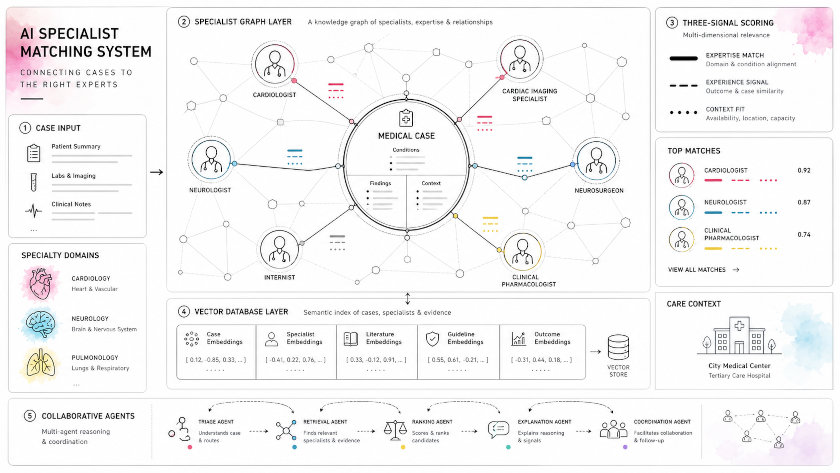
Spring AI Agentic Patterns: Agent Skills for Clinical Decision Support
Medical AI systems have requirements that most general-purpose chatbot tutorials ignore. Hallucination in a consumer app is an annoyance; in a clinical workflow it is a patient-safety issue. Knowledge must be versioned, auditable, and updateable without a production deployment. And because the medical LLM landscape is evolving fast — MedGemma today, something better tomorrow — the stack must stay vendor-agnostic.
This post shows how med-expert-match-ce, a Spring Boot 4 specialist-matching system, addresses these concerns using Agent Skills from the spring-ai-agent-utils library. Nine domain-specific skills cover the full clinical pipeline: triage, case analysis, doctor matching, evidence retrieval, routing, and network analytics — none of them hardcoded into Java.
⚠️ Not a Production-Ready System — This is a research and educational project demonstrating AI agentic patterns. It is not certified for clinical use, not HIPAA-compliant, and not intended for real patient care. All outputs must be reviewed by qualified medical professionals before any clinical decision is made.
The Problem: Why Medical AI Needs Modular Skill Architecture
General-purpose LLM applications stuff everything into one massive prompt. This works for demos but breaks down in healthcare for three reasons:
- Domain knowledge changes — Clinical guidelines, drug interactions, and diagnostic criteria evolve. Updating a hardcoded prompt means redeploying code.
- Token cost scales poorly — A 50-skill system that loads all skills on every request wastes context window and budget on skills that aren't relevant to the current turn.
- Provenance matters — When an LLM recommends a specialist, you need to know which guideline or evidence source grounded that decision — not just the final output.
Spring AI's Agent Skills pattern addresses these by treating skills as first-class, versioned artifacts that are discovered and loaded only when needed.
Skills vs. Tools vs. Medical Workflows
A common point of confusion is conflating three distinct concepts:
| Concept | Definition | Example in med-expert-match-ce |
|---|---|---|
| Skill | A reusable instruction package: Markdown file with YAML frontmatter, optional scripts, and assets. Loaded progressively — only when semantically matched by the LLM. | triage/SKILL.md with urgency classification instructions |
| Tool | A mechanism the model can call at runtime. Exposes external capabilities like file reading, script execution, or database queries. | SkillsTool registry, AutoMemoryTools, ShellTools |
| Medical Workflow | The domain task — the business logic that combines skills and tools to accomplish a clinical objective. | Matching a patient case to optimal specialists using three-signal scoring |
The critical boundary: A skill contains instructions (what to do); a tool provides execution (how to do it); a workflow orchestrates both to achieve a domain outcome.
How Skills Work: Architecture and Execution Flow
Spring AI describes the skill lifecycle in three stages: discovery, activation, and execution. The flow is:
View Mermaid source code
sequenceDiagram
    actor User
    participant SkillsTool as SkillsTool<br/>(registry)
    participant LLM
    participant Skill as SKILL.md<br/>(loaded on demand)
    participant Tool as @Tool method
    participant Service as Domain Service

    User->>SkillsTool: User message
    SkillsTool->>LLM: Registry (names + descriptions only)
    LLM-->>SkillsTool: Semantic match: "triage" skill identified
    SkillsTool->>Skill: Load full SKILL.md into context
    Skill->>Tool: Model calls tool function
    Tool->>Service: Tool invokes Spring service
    Service-->>Tool: Structured result
    Tool-->>Skill: Tool response in context
    Skill-->>User: Generated response with rationale
- Discovery — At startup,
SkillsToolscanssrc/main/resources/skills/directories and extracts onlynameanddescriptionfrom eachSKILL.mdfrontmatter. This lightweight registry is sent to the LLM. - Activation — When a user message semantically matches a skill, the model invokes
Skill("skill-name"). Only then is the fullSKILL.mdcontent loaded into the context window. - Execution — Inside the skill's instructions, the model decides which
@Toolmethods to call. Tools execute in the local environment (no sandbox by default) and return results into the skill's context.
Important: Scripts referenced by a skill execute directly in the local environment without sandboxing. This is fine for read-only operations but requires careful scoping for anything that modifies state.
The Medical Example: med-expert-match-ce
med-expert-match-ce is a Spring Modulith monolith — 18 modules with compile-time-enforced boundaries — that uses Agent Skills for specialist matching in a clinical setting.
End-to-End Example: Triage a New Case
Input (user message):
New case: 58-year-old male, acute chest pain radiating
to the left arm, diaphoresis, elevated troponin.
Assess urgency.
Skill activated: triage
Skill instructions (triage/SKILL.md excerpt):
## Urgency Levels
- **CRITICAL** — life-threatening; immediate attention required
- **HIGH** — urgent; attention required within hours

## Output
Return structured JSON with urgencyLevel, rationale, redFlags, recommendedAction.
Tool invoked: None (triage is pure LLM classification based on instructions)
Output:
{
  "urgencyLevel": "CRITICAL",
  "rationale": "Classic ACS presentation — immediate cardiology consult required",
  "redFlags": ["chest pain", "radiation to arm", "diaphoresis", "elevated troponin"],
  "recommendedAction": "Emergency cardiology consult"
}
This demonstrates progressive disclosure: the LLM saw only the lightweight registry at startup, paid token cost for only the triage skill when needed, and produced a structured clinical response.
System Overview
med-expert-match-ce is structured as a strict Spring Modulith monolith — 18 modules with compile-time-enforced boundaries. The LLM layer sits in the llm module and depends on 11 others.
View Mermaid source code
graph TB
    subgraph "Web Layer"
        UI[Thymeleaf SSR]
        REST[REST Controllers]
    end

    subgraph "LLM Module"
        CA[ChatClient + SkillsTool]
        PA[PlannerAgent]
        CBA[ContextBuilderAgent]
        EA[ExecutionAgent]
        LCA[LlmUsageCaptureAdvisor]
        AM[AutoMemoryTools]
        SM[SessionMemoryAdvisor]
    end

    subgraph "Retrieval Module"
        DR[DoctorMatchService]
        SR[SemanticGraphRetrievalService]
        RR[RerankingService]
    end

    subgraph "Domain Modules"
        MC[medicalcase]
        DOC[doctor]
        CE[clinicalexperience]
        FAC[facility]
        EV[evidence / PubMed]
    end

    subgraph "Infrastructure"
        PG[(PostgreSQL 17)]
        VEC[(pgvector 1536-dim)]
        AGE[(Apache AGE graph)]
    end

    UI --> CA
    REST --> CA
    CA --> PA
    PA -->|PlanReadyEvent| CBA
    CBA -->|ContextReadyEvent| EA
    EA --> DR
    DR --> SR
    SR --> VEC
    SR --> AGE
    SR --> CE
    DR --> RR
    CA --> LCA
    CA --> SM
    CA --> AM
    DR --> MC
    DR --> DOC
    DR --> FAC
    PG --> VEC
    PG --> AGE
The event-driven sub-pipeline (PlannerAgent → ContextBuilderAgent → ExecutionAgent) is activated by the Spring profile event-driven. On the default profile, the ChatClient calls workflow engines directly.
Domain Model
Three records anchor the matching domain.
MedicalCase
// medicalcase/domain/MedicalCase.java
public record MedicalCase(
    String id,                          // CHAR(24) hex ID
    Integer patientAge,                 // anonymised
    String chiefComplaint,
    String symptoms,
    String currentDiagnosis,
    List<String> icd10Codes,            // ICD-10 classification
    List<String> snomedCodes,           // SNOMED-CT codes
    UrgencyLevel urgencyLevel,          // CRITICAL / HIGH / MEDIUM / LOW
    String requiredSpecialty,
    CaseType caseType,                  // INPATIENT / SECOND_OPINION / CONSULT_REQUEST
    String additionalNotes,
    String abstractText,                // embedding source
    BigDecimal locationLatitude,
    BigDecimal locationLongitude
) {}
Doctor
// doctor/domain/Doctor.java
public record Doctor(
    String id,
    String name,
    List<String> specialtyIds,          // array-ref, no FK
    List<String> icd10CodeRanges,       // competency breadth
    Boolean telehealthCapable,
    String availabilityStatus,
    BigDecimal locationLatitude,
    BigDecimal locationLongitude
) {}
ClinicalExperience
ClinicalExperience stores per-doctor-per-case outcomes — the historical signal in the three-signal scorer.
// clinicalexperience/domain/ClinicalExperience.java
public record ClinicalExperience(
    String id,
    String doctorId,
    String caseId,
    String outcome,          // RESOLVED, IMPROVED, REFERRED, ...
    Integer complexityLevel,
    String facilityId,
    Instant recordedAt
) {}
Array-based references (List<String> instead of foreign keys) are an architectural decision (ADR D-013). PostgreSQL GIN indexes on TEXT[] columns make containment queries fast without JOIN overhead.
The Three-Signal Scorer
Doctor-to-case matching blends three independent signals into a single score in the 0–100 range.
View Mermaid source code
flowchart LR
    subgraph Inputs
        C[MedicalCase<br/>embedding]
        D[Doctor<br/>profile]
    end

    subgraph "Signal 1 — Vector (40%)"
        VEC[pgvector cosine<br/>similarity]
    end

    subgraph "Signal 2 — Graph (30%)"
        GR[Apache AGE<br/>Cypher traversal]
    end

    subgraph "Signal 3 — History (30%)"
        HI[ClinicalExperience<br/>outcomes]
    end

    subgraph Fusion
        WA["Weighted Average<br/>or RRF (k=60)"]
        RERANK[Semantic<br/>Re-ranker]
    end

    C --> VEC
    D --> VEC
    C --> GR
    D --> GR
    D --> HI
    VEC -->|0.4| WA
    GR  -->|0.3| WA
    HI  -->|0.3| WA
    WA --> RERANK
    RERANK --> Score["Score 0–100<br/>+ rationale"]
The weights are configurable in application.yml; optional Reciprocal Rank Fusion (k=60) can replace the weighted average for re-ranking large candidate sets.
The Nine Medical Skills
src/main/resources/skills/
├── case-analyzer/       SKILL.md
├── clinical-advisor/    SKILL.md
├── clinical-guideline/  SKILL.md
├── doctor-matcher/      SKILL.md
├── evidence-retriever/  SKILL.md
├── network-analyzer/    SKILL.md
├── recommendation-engine/ SKILL.md
├── routing-planner/     SKILL.md
└── triage/              SKILL.md
| Skill | Triggered when | Purpose | Backed by |
|---|---|---|---|
triage | New case enters the system | Classify case urgency (CRITICAL/HIGH/MEDIUM/LOW) and identify red flags for queue routing | LLM urgency classifier |
case-analyzer | "Find Specialist" or chat intake | Extract ICD-10/SNOMED codes, chief complaint, and symptoms from unstructured case text | Clinical LLM → ICD-10/SNOMED extraction |
doctor-matcher | Case analysis complete | Score and rank doctors against a case using vector similarity, graph proximity, and historical outcomes | Three-signal pipeline (vector + graph + history) |
evidence-retriever | Case needs supporting literature | Fetch relevant PubMed articles and local RAG context to ground recommendations in evidence | PubMed E-utilities + local pgvector search |
clinical-advisor | Differential diagnosis requested | Provide risk assessment and historical outcome context for potential diagnoses | ClinicalExperience history + risk LLM |
recommendation-engine | Matches found, synthesis needed | Generate treatment plan suggestions and referral rationale with evidence grounding | Clinical LLM → treatment plan + referral rationale |
routing-planner | "Where should this patient go?" | Score facilities by complexity capability, historical outcomes, bed capacity, and geographic proximity | Facility scorer: complexity × outcomes × capacity × proximity |
network-analyzer | Expertise-network analytics | Query the doctor-facility-specialty graph to find hidden referral patterns and sub-specialty clusters | Apache AGE Cypher graph queries |
clinical-guideline | Guideline grounding needed | Retrieve and apply relevant CPG (Clinical Practice Guidelines) and GRADE evidence quality ratings | CPG + GRADE citation logic |
doctor-matcher skill (full example)
---
name: doctor-matcher
description: Match doctors to medical cases using multiple signals
             including vector similarity, graph relationships,
             and historical performance
---

# Doctor Matcher

## When to Use This Skill
- User needs to find specialists for a medical case
- You need to score and rank doctor-case matches
- You need to prioritize doctors based on historical performance

## Available Tools

### querycandidatedoctors
Finds candidate doctors based on case requirements and filters.

Parameters:
- `caseId` — the medical case ID (required)
- `specialty` — required medical specialty (optional)
- `requireTelehealth` — filter to telehealth-capable doctors (optional)
- `maxResults` — maximum number of results, default 10

Returns a list of candidate doctors matching the criteria.

### matchdoctorstocase
Runs the full three-signal match-and-score pipeline for a case.

Parameters:
- `caseId` — the medical case ID
- `maxResults` — default 10
- `minScore` — score threshold (optional)
- `preferredSpecialties` — preferred specialty list (optional)
- `requireTelehealth` — boolean (optional)

Returns doctor matches sorted by score (1 = best match),
with per-signal breakdown and rationale.

## Output Format
For every match provide:
- **Doctor** — name, specialty, certifications, availability
- **Score** — overall 0–100 with component breakdown (vector / graph / history)
- **Rank** — position in results (1 = best match)
- **Rationale** — why this doctor was selected

## Workflow
1. Analyse the case — identify required specialty, urgency, complexity
2. Call `querycandidatedoctors` to get the filtered candidate pool
3. Call `matchdoctorstocase` to score and rank the pool
4. Apply thresholds or preference filters as needed
5. Return ranked results with full rationale

## Medical Disclaimer
All matches are for research and educational purposes only.
Results must be reviewed by qualified medical professionals
before any clinical decision is made.
triage skill
---
name: triage
description: Assess urgency level for new medical cases. Use when a
  new case enters the system to classify as CRITICAL, HIGH, MEDIUM,
  or LOW priority tier for queue routing.
---

# Triage

## Urgency Levels
- **CRITICAL** — life-threatening; immediate attention required (chest pain, stroke, severe dyspnea)
- **HIGH** — urgent; attention required within hours
- **MEDIUM** — important; attention required within days
- **LOW** — routine; attention within weeks
Output
Return structured JSON:
{
  "urgencyLevel": "CRITICAL",
  "rationale": "Acute chest pain with diaphoresis — ACS must be excluded immediately",
  "redFlags": ["chest pain", "diaphoresis", "elevated troponin"],
  "recommendedAction": "Emergency cardiology consult"
}
Event-Driven Agent Pipeline
When the event-driven Spring profile is active, the llm module decomposes every user request into a three-stage pipeline mediated by Spring ApplicationEvents. This decouples intent recognition, context assembly, and execution — each stage can be profiled, retried, and tested independently.
View Mermaid source code
sequenceDiagram
    participant U as User
    participant CC as ChatClient
    participant PA as PlannerAgent
    participant CBA as ContextBuilderAgent
    participant EA as ExecutionAgent
    participant DR as DoctorMatchService
    participant DB as "PostgreSQL / pgvector / AGE"

    U->>CC: "Find a cardiologist for case abc123"
    CC->>PA: GoalIdentifiedEvent(sessionId, classification)
    PA->>CBA: PlanReadyEvent(sessionId, plan{intent=MATCH, caseId=abc123})
    CBA->>DB: Load MedicalCase, embeddings, graph context
    DB-->>CBA: CaseContextBundle
    CBA->>EA: ContextReadyEvent(sessionId, bundle)
    EA->>DR: doctorMatchWorkflowEngine.execute(caseId, request)
    DR->>DB: vector similarity query (pgvector)
    DR->>DB: graph proximity query (Apache AGE Cypher)
    DR->>DB: historical outcomes query (ClinicalExperience)
    DB-->>DR: scores
    DR-->>EA: List<DoctorMatch> sorted by score
    EA->>CC: ResultsReadyEvent(sessionId, response)
    CC-->>U: Ranked matches with rationale
Each agent is a plain Spring @Component with an @EventListener method:
// llm/agent/ContextBuilderAgent.java
@Slf4j
@Component
@Profile("event-driven")
@RequiredArgsConstructor
public class ContextBuilderAgent {

    private final ApplicationEventPublisher eventPublisher;
    private final CaseContextBundleService   caseContextBundleService;
    private final PipelineMetricsService     pipelineMetrics;
    private final PipelineProgressCollector  pipelineProgressCollector;

    @EventListener
    public void onPlanReady(PlanReadyEvent event) {
        long start = System.currentTimeMillis();
        log.info("ContextBuilderAgent: plan ready session={} steps={}",
            event.sessionId(), event.plan().steps().size());

        pipelineProgressCollector.addStage(event.sessionId(), CONTEXT_BUILD, "ContextBuilder");

        String          caseId  = findCaseId(event.plan());
        CaseContextIntent intent = resolveIntent(event.plan());

        CaseContextBundle bundle = caseContextBundleService.build(caseId, intent);

        pipelineMetrics.recordContextBuild(event.sessionId(),
            System.currentTimeMillis() - start);

        eventPublisher.publishEvent(
            new ContextReadyEvent(event.sessionId(), bundle, Instant.now()));
    }
}
Three-Signal Matching — Implementation
The DoctorMatchServiceImpl orchestrates the three signals, guards against semantically empty cases, and applies optional re-ranking.
// retrieval/service/impl/DoctorMatchServiceImpl.java
@Service
@RequiredArgsConstructor
@Transactional(readOnly = true)
public class DoctorMatchServiceImpl implements DoctorMatchService {

    private final MedicalCaseRepository         medicalCaseRepository;
    private final SemanticGraphRetrievalService  semanticGraphRetrievalService;
    private final RerankingService               rerankingService;

    @Override
    public List<DoctorMatch> matchDoctorsForCase(
            String caseId, MatchOptions options) {

        String normalizedId = caseId.trim().toLowerCase();

        MedicalCase medicalCase = medicalCaseRepository
            .findById(normalizedId)
            .orElseThrow(() -> new IllegalArgumentException(
                "Medical case not found: " + caseId));

        // Guard: reject cases that contain only ObjectId placeholders
        if (hasInsufficientMedicalData(medicalCase)) {
            log.warn("Case {} has insufficient clinical data for matching", caseId);
            return List.of();
        }

        List<Doctor> candidates = findCandidateDoctors(medicalCase, options);

        List<DoctorMatch> unsorted = candidates.stream()
            .filter(d -> !options.excludedDoctorIds().contains(d.id()))
            .map(doctor -> {
                ScoreResult score =
                    semanticGraphRetrievalService.score(medicalCase, doctor);
                return new DoctorMatch(
                    doctor,
                    score.overallScore(),
                    0,           // rank assigned after sort
                    score.rationale());
            })
            .filter(m -> options.minScore() == null
                         || m.matchScore() >= options.minScore())
            .collect(toList());

        List<DoctorMatch> sorted = unsorted.stream()
            .sorted(comparingDouble(DoctorMatch::matchScore).reversed())
            .collect(toList());

        // Optional semantic re-ranking (disabled by default via feature flag)
        return rerankingService.rerank(normalizedId, sorted, options.maxResults());
    }

    /**
     * A case has insufficient data if all three clinical fields are blank
     * or contain only 24-character hex ObjectId strings.
     */
    private boolean hasInsufficientMedicalData(MedicalCase c) {
        return !isRealMedicalTerm(c.chiefComplaint())
            && !isRealMedicalTerm(c.currentDiagnosis())
            && (c.icd10Codes() == null
                || c.icd10Codes().stream().noneMatch(this::isRealMedicalTerm));
    }

    private boolean isRealMedicalTerm(String value) {
        if (value == null || value.isBlank()) return false;
        // Reject bare ObjectId hex strings (24 hex chars)
        if (value.trim().matches("[0-9a-fA-F]{24}")) return false;
        return value.trim().chars().anyMatch(Character::isLetter);
    }
}
LLM Telemetry Advisor
Every LLM call — regardless of which skill triggered it — passes through LlmUsageCaptureAdvisor. The advisor intercepts both blocking and streaming calls, records latency and token counts, and publishes a LlmCallSnapshot to the Prometheus-backed LlmUsageTelemetryService.
// llm/advisor/LlmUsageCaptureAdvisor.java
public class LlmUsageCaptureAdvisor implements CallAdvisor, StreamAdvisor {

    private final LlmUsageTelemetryService telemetryService;

    @Override
    public String getName() { return "llmUsageCaptureAdvisor"; }

    @Override
    public int getOrder() { return Ordered.LOWEST_PRECEDENCE; }

    // --- Blocking call ---
    @Override
    public ChatClientResponse adviseCall(
            ChatClientRequest request, CallAdvisorChain chain) {
        long start = System.nanoTime();
        ChatClientResponse response = chain.nextCall(request);
        record(request, response, start);
        return response;
    }

    // --- Streaming call ---
    @Override
    public Flux<ChatClientResponse> adviseStream(
            ChatClientRequest request, StreamAdvisorChain chain) {
        long start = System.nanoTime();
        AtomicReference<ChatClientResponse> last = new AtomicReference<>();
        return chain.nextStream(request)
            .doOnNext(last::set)
            .doOnComplete(() -> record(request, last.get(), start));
    }

    private void record(
            ChatClientRequest request,
            ChatClientResponse response,
            long startNanos) {
        if (response == null) return;
        long latencyMs = Math.max(0L, (System.nanoTime() - startNanos) / 1_000_000L);
        LlmCallSnapshot snapshot = LlmCallSnapshot.fromProvider(
            response, request,
            LlmUsageContextHolder.getOrDefault(), latencyMs);
        telemetryService.record(snapshot);
    }
}
Six role-separated endpoints — CLINICAL_HIGH, CLINICAL_LOW, UTILITY, TOOL_CALLING, EMBEDDING, RERANK — are each tracked individually. This enables per-role cost accounting and quality monitoring in Grafana.
Four-Tier LLM Inference Pipeline
Not every request needs MedGemma 27B. The routing layer assigns each sub-task to the cheapest tier capable of producing sufficient quality.
View Mermaid source code
flowchart TD
    REQ[Incoming request]

    REQ --> T0{T0: Deterministic?}
    T0 -->|yes| D0[Rule-based logic<br/>no LLM cost]
    T0 -->|no| T1{T1: Light task?}

    T1 -->|yes| D1[MedGemma 4B<br/>CLINICAL_LOW endpoint<br/>triage, classification]
    T1 -->|no| T2{T2: Utility task?}

    T2 -->|yes| D2[Utility model<br/>TOOL_CALLING / RERANK<br/>embeddings, re-ranking]
    T2 -->|no| D3[MedGemma 27B<br/>CLINICAL_HIGH endpoint<br/>full clinical analysis]

    D3 -->|cost + latency ok?| OUT[Response]
    D0 --> OUT
    D1 --> OUT
    D2 --> OUT
The tier assignment is declared in LlmTierConfiguration and resolved by a LlmTierRoutingService at request time. Per-tier Prometheus counters track cost, latency, and quality signals from the evaluation flywheel.
Session Memory and AutoMemory
Two complementary memory mechanisms preserve context across turns and sessions.
Sliding-window session memory
// Compact after 15 turns; hard limit 30 events; JDBC-persisted
SessionMemoryAdvisor memoryAdvisor = new SessionMemoryAdvisor(
    jdbcSessionStore,
    new SlidingWindowCompactionStrategy(15, 30));
AutoMemory — durable cross-session facts
Durable facts (patient preferences, doctor notes, recurring case patterns) are stored as Markdown files under ~/.medexpertmatch/auto-memory/. Explicit AutoMemoryTools give the agent full control over what gets persisted and when — deliberate recall rather than implicit injection.
~/.medexpertmatch/auto-memory/
├── doctor-prefs-abc123.md     # "Dr. Smith prefers cardiology referrals via telehealth"
├── case-patterns-2026-06.md   # recurring chief-complaint patterns this month
└── session-notes-xyz.md       # cross-session continuity notes
The explicit-tools approach (ADR D-011) was chosen over AutoMemoryToolsAdvisor to maintain agent control over what constitutes a "durable fact" — important in a medical context where stale or incorrect remembered facts could affect downstream recommendations.
Module Boundaries (Spring Modulith)
The llm module's allowed dependencies are declared in package-info.java:
// llm/package-info.java
@org.springframework.modulith.ApplicationModule(
    allowedDependencies = {
        "core",
        "doctor",
        "medicalcase",
        "clinicalexperience",
        "medicalcoding",
        "facility",
        "graph",
        "embedding",
        "retrieval",
        "caseanalysis",
        "evidence"
    }
)
package com.berdachuk.medexpertmatch.llm;
Spring Modulith enforces these boundaries at compile time via @ApplicationModuleTest. Any attempt to call across a non-declared boundary fails the build — guaranteeing that the LLM orchestration layer never reaches directly into, say, the ingestion module's internals.
Prompt Templates as External Resources
Following ADR D-004, no prompt string is hardcoded in Java. Every .st (StringTemplate) file lives in src/main/resources/prompts/ and is wired via PromptTemplate.builder():
// core/config/PromptTemplateConfig.java
@Configuration
public class PromptTemplateConfig {

    @Bean
    public PromptTemplate caseAnalysisPrompt(ResourceLoader resourceLoader) {
        return PromptTemplate.builder()
            .renderer(StTemplateRenderer.builder().build())
            .resource(resourceLoader.getResource(
                "classpath:prompts/case-analysis.st"))
            .build();
    }

    @Bean
    public PromptTemplate doctorMatchRationalePrompt(ResourceLoader resourceLoader) {
        return PromptTemplate.builder()
            .renderer(StTemplateRenderer.builder().build())
            .resource(resourceLoader.getResource(
                "classpath:prompts/doctor-match-rationale.st"))
            .build();
    }
}
Updating clinical reasoning instructions becomes a one-file change — no recompilation, no schema migration, no deployment if templates are loaded from a mounted volume.
Configuring the Agent with Skills
1. Maven dependency
<!-- pom.xml -->
<dependency>
    <groupId>org.spring-ai-community</groupId>
    <artifactId>spring-ai-agent-utils</artifactId>
    <version>0.9.0</version>
</dependency>
Spring AI BOM: 2.0.0. Spring Boot: 4.1.0.
2. ChatClient bean
// llm/config/MedicalAgentConfiguration.java
@Configuration
@RequiredArgsConstructor
public class MedicalAgentConfiguration {

    private final ResourceLoader resourceLoader;

    @Bean
    public ChatClient medicalAgentChatClient(
            ChatClient.Builder builder,
            LlmUsageCaptureAdvisor usageAdvisor,
            SessionMemoryAdvisor memoryAdvisor,
            AutoMemoryTools autoMemoryTools) {

        return builder
            // Skills loaded from classpath JAR — no file-system dependency
            .defaultToolCallbacks(
                SkillsTool.builder()
                    .addSkillsResource(
                        resourceLoader.getResource("classpath:skills"))
                    .build())
            // Durable cross-session memory stored at ~/.medexpertmatch/auto-memory/
            .defaultTools(autoMemoryTools)
            .defaultAdvisors(
                usageAdvisor,           // LLM telemetry + Prometheus
                memoryAdvisor)          // sliding-window JDBC session memory
            .build();
    }
}
SkillsTool.builder().addSkillsResource(...) accepts any Spring Resource — classpath, file system, or a custom ResourceLoader. Loading from classpath keeps the production JAR self-contained.
Evaluation: Testing and Quality Assurance
A production clinical AI system requires rigorous evaluation. The current project addresses this through:
Accuracy Checks
- Synthetic test cases with known ICD-10/SNOMED codes verify extraction accuracy
- Benchmark datasets compare three-signal scores against expert physician rankings
Domain Review
- Every
SKILL.mdchange requires a PR reviewed by both a software engineer and a clinical domain expert - Skill descriptions and output formats are validated against current clinical guidelines
Prompt and Version Control
- All skill instructions are versioned in Git alongside the code
- Git tags align application releases with skill releases for auditability
- Changes to skills trigger regression tests in the CI pipeline
Failure Handling
- Cases with insufficient clinical data (missing chief complaint, diagnosis, or codes) return empty results rather than hallucinated matches
hasInsufficientMedicalData()guards against bare ObjectId placeholder strings being treated as valid medical terms- Telemetry tracks per-role failure rates for quality monitoring
Safe Use in Healthcare
🔴 Do NOT Use This System For:
- Autonomous diagnosis — No AI system should generate a diagnosis without clinician review
- Treatment prescribing — Medication decisions require licensed physician judgment
- Unsupervised triage — All urgency classifications must be confirmed by qualified staff
- Autonomous referral routing — Specialist assignments need physician approval
Appropriate Uses (Lower Risk)
| Use Case | Risk Level | Requirement |
|---|---|---|
| Clinical documentation assistance | Low | Clinician reviews all output |
| Protocol and guideline retrieval | Low | Verify against current authoritative sources |
| Educational scenarios | Low | Clearly labeled as training/research |
| Literature search assistance | Medium | Clinician validates relevance and applicability |
| Differential diagnosis consideration | High | Must be advisory only, not sole basis for decisions |
What the Reference Implementation Does NOT Provide
The Spring AI spring-ai-agent-utils library provides no built-in:
- Sandboxing for script execution
- Human-in-the-loop approval gates
- Audit logging of skill invocations
- Version diffing or rollback for skills
- Clinical safety certifications
For any workflow that could influence diagnosis, prescribing, or treatment, you must implement these safeguards as application-level concerns outside the skill system itself.
Getting Started
Step 1 — Add the dependency
<dependency>
    <groupId>org.spring-ai-community</groupId>
    <artifactId>spring-ai-agent-utils</artifactId>
    <version>0.9.0</version>
</dependency>
Step 2 — Create a skill
mkdir -p src/main/resources/skills/triage
# src/main/resources/skills/triage/SKILL.md
---
name: triage
description: Assess urgency level for new medical cases and classify
  as CRITICAL, HIGH, MEDIUM, or LOW.
---

## Instructions
Extract chief complaint, check for life-threatening red flags,
return urgencyLevel + rationale as JSON.
Step 3 — Register SkillsTool
ChatClient client = ChatClient.builder(chatModel)
    .defaultToolCallbacks(
        SkillsTool.builder()
            .addSkillsResource(
                resourceLoader.getResource("classpath:skills"))
            .build())
    .build();
Step 4 — Call the agent
String result = client.prompt()
    .user("""
        New case: 58-year-old male, acute chest pain radiating
        to the left arm, diaphoresis, elevated troponin.
        Assess urgency.
        """)
    .call()
    .content();

// LLM activates skill "triage" automatically.
// Returns:
// {
//   "urgencyLevel": "CRITICAL",
//   "rationale": "Classic ACS presentation — immediate cardiology consult required",
//   "redFlags": ["chest pain", "radiation to arm", "diaphoresis", "elevated troponin"]
// }
Key Design Decisions
| ADR | Decision | Rationale |
|---|---|---|
| D-001 | Java records for domain entities | Immutable, RowMapper-friendly, less mutation bugs |
| D-004 | External .st prompt templates | Iterate on clinical reasoning without recompilation |
| D-006 | OpenAI-compatible providers only | Single integration surface; swap models without code changes |
| D-007 | Six role-separated LLM endpoints | Per-role cost tracking, quality monitoring, independent scaling |
| D-009 | Graph ops only through GraphService | Prevents Cypher injection; single point for graph schema changes |
| D-011 | AutoMemory via explicit tools | Agent controls what is remembered — critical in clinical contexts |
| D-012 | Four-tier inference pipeline | Use heavy models only when lighter tiers are insufficient |
| D-013 | Array-based references, no FKs | Fast GIN containment queries on read-heavy medical data |
Resources
- Repository: berdachuk/med-expert-match-ce
- Spring AI Agent Utils: spring-ai-community/spring-ai-agent-utils
- Spring Blog post: Spring AI Agentic Patterns (Part 1): Agent Skills
- Spring AI Reference: docs.spring.io/spring-ai
- Apache AGE: age.apache.org
- pgvector: github.com/pgvector/pgvector
Published on 6/14/2026