Qwen3.8-27B-NVFP4 on a 24GB RTX 4090: What a Dense Model Can and Cannot Do
A 27B dense model is a different serving problem than a 35B MoE model. The MoE checkpoint offloads its expert pool to host RAM and leaves room for a 262K-token KV cache on a 24GB card. The dense checkpoint has nothing to offload: its weights sit in VRAM, and the KV cache gets whatever is left.
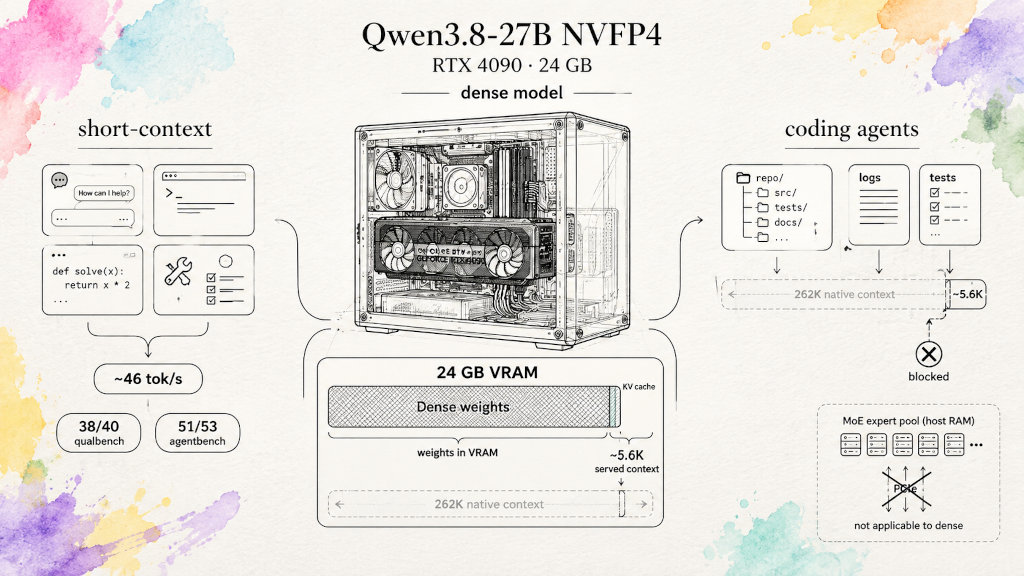
This article measures exactly what is left, on one specific deployment: Qwen3.8-27B-NVFP4 (NVIDIA Model Optimizer mixed-precision release) served by FreeToken on an RTX 4090 (24.5 GiB). The headline result is two-sided:
- The model fits and serves, and scores well on short-context evals (38/40 qualbench, 51/53 agentbench).
- The KV ceiling is ~5.6K tokens, not the advertised 262,144. On this card, the dense 27B is a short-context interactive model, not a long-context coding server.
Why dense changes the math
Qwen3.6-35B-A3B (the model this site's earlier FreeToken articles serve) is a
sparse MoE: 256 experts, 8 active per token. FreeToken's --moe-backend offload keeps the 31.4 GiB expert pool in host RAM and only the hot working
set in VRAM. That is why a 35 GB checkpoint runs on a 24 GB card with a
300K-token KV reservation.
Qwen3.8-27B is dense: num_experts == 0, every parameter executes for
every token. There is no expert pool to offload, so the --moe-* knobs are
inert. The full weight set must live in VRAM, and the KV cache is a
second-class citizen.
The model and the setup
| Parameter | Value |
|---|---|
| Checkpoint | nvidia/Qwen3.8-27B-NVFP4 (Model Optimizer 0.47.0.dev0) |
| Quantization | Mixed precision: MLP gate/up/down_proj NVFP4 (group 16), attention FP8, lm_head/embed_tokens/norms BF16 |
| On-disk size | 21 GiB (3 safetensors shards, 2194 tensors incl. 333 vision tensors skipped for text-only) |
| Architecture | Dense, 64 layers, hybrid attention (16 full + 48 GatedDeltaNet), hidden 5120, 24 Q-heads / 4 KV-heads, max_position_embeddings 262144 |
| Server | FreeToken main @ af71ba4, CUDA 13.0, froggeric v22.4 chat template |
| GPU | RTX 4090, 24.5 GiB VRAM, PCIe 4.0 x8 |
| RAM | 125 GiB (87 GiB available) |
The chat template was patched to froggeric v22.4 (the same template the 3.6
deployment uses), with the stock template preserved as .orig.
What actually fits: measured, not estimated
The launch sequence tells the real story. Free VRAM before model load: 23.07 GiB. After the mixed-precision weights load and CUDA graphs are captured: 2.04 GiB free (nvidia-smi shows 22.0–22.3 GiB used of 24.5 GiB).
The KV allocator clamps to what fits, not what was requested.
--kv-reserve-tokens 8192, 32768, and 65536 all produced the same
result:
Allocating 5577 tokens for KV cache, K + V = 0.34 GiB
With --max-running-requests 4 and --kv-reserve-tokens 65536, the server
refused to start at all:
AssertionError: Not enough memory for KV cache, try reducing --num-pages
The working profile is deliberately small:
ft serve \
  --model /mnt/data/berda-models/models/Qwen3.8-27B-NVFP4 \
  --served-model-name qwen3.8-27b-nvfp4 \
  --host 0.0.0.0 --port 8000 \
  --cuda-graph-max-bs 1 --max-running-requests 1 \
  --kv-reserve-tokens 32768 \
  --num-tokenizer 0 \
  --tool-call-parser qwen3_coder --reasoning-parser qwen3
--max-running-requests 1 also shrinks the GatedDeltaNet linear-state pool
(25→21 slots), which is part of why this profile fits where the 4-request
profile asserts.
In practice, "maximum context" for this model on this card is ~5.6K
tokens, roughly the default floor, not the model's native 262K. The
advertised max_model_len: 262144 in /v1/models is the model's ceiling,
not the served budget; trust the startup log line, not the metadata.
Correctness: qualbench 38/40 (short-context categories)
The qualbench suite (50 tasks, 6 categories) was run against the live server. The long-context category (8K–150K-token needle-in-haystack) was excluded: it cannot fit in a 5.6K KV budget. The remaining 40 tasks:
| Category | Pass | Notes |
|---|---|---|
| Java/Spring bugfix | 10/10 | |
| TypeScript/Angular bugfix | 8/8 | |
| SQL migrations | 4/6 | Tasks 02, 03 failed in verify.sh |
| MCP/tool-call | 8/8 | Including the by-design hallucination probe (task 06) |
| Security review | 8/8 | |
| Total | 38/40 |
The two SQL failures are migration-application errors (a unique-constraint
dupe handling issue and a DROP COLUMN blocked by a dependent view), not
truncation or server faults.
Correctness: agentbench 51/53
The wire-protocol suite (OpenAI chat completions, Responses, Anthropic Messages) ran 51 passed / 2 failed / 11 skipped / 2 xfailed in 116 seconds. The two failures share one pattern:
test_reasoning_plus_tool_call_replays_cleanlytest_full_bugfix_loop_completes_with_final_summary
Both send reasoning_effort="high" with a 300-token output budget. The model
spent the entire budget on its reasoning trace (finish_reason: length,
content: '') and never emitted the tool call. This is the same
reasoning-budget trap documented for the 3.6 deployment, but the 3.8-NVFP4
checkpoint is more verbose in reasoning, so tests that pass on 3.6 fail here.
It is model-specific behavior under a fixed budget, not a server bug and not
a flake.
The 11 skipped tests are 3 chat-template checks (no local template path) and 8 opt-in tests (concurrency + large-context) that require more KV than this card can give the dense model.
Speed
Decode throughput on the 4090 was ~46 tok/s at --max-running-requests 1
(GPU 100%), with prefill at ~32 tok/s for a 587-token prompt. The full
40-task qualbench run took 821 seconds (~14 min), faster than the 3.6
MoE run on the same card, as expected for a smaller dense model.
What this means in practice
- For short-context interactive use (chat, quick tool calls, small prompts), the dense 27B-NVFP4 is a strong fit on a 24GB card: it serves, it is fast, and it scores well on the short-context evals.
- For long-context coding agents, it is not a replacement for the MoE-based 3.6-35B-A3B deployment. The 5.6K KV ceiling means any prompt over ~5K tokens fails, and the agentbench large-context tests cannot run.
- The advertised context is not the served context. This is the same lesson as the 3.6 article, in a sharper form: the model card says 262K, the server says 5.6K, and the difference is the weight footprint, not a misconfiguration.
Lessons
- Dense models do not get the MoE offload trick. The RAM/PCIe path that makes a 35B MoE fit a 24GB card is unavailable to a dense 27B. Weights live in VRAM; KV gets the remainder.
- The KV allocator clamps, it does not fail. An oversized
--kv-reserve-tokenssilently produces the largest allocation that fits (5,577 tokens here), or, with a larger request profile, a hard startup assertion. Read the startup log line, not the flag value. - Reasoning-budget truncation is model-specific. The same
reasoning_effort="high"+ 300-token budget that passes on 3.6 fails on 3.8-NVFP4 because the checkpoint reasons more verbosely. When you change models, re-check the reasoning-budget tests. max_model_lenin/v1/modelsis a model property, not a deployment property. The served budget is what the startup log says it is.
Resources
- FreeToken GitHub repository: https://github.com/FlashML-org/FreeToken
- nvidia/Qwen3.8-27B-NVFP4: https://huggingface.co/nvidia/Qwen3.8-27B-NVFP4
- Qwen/Qwen3.8-27B-FP8: https://huggingface.co/Qwen/Qwen3.8-27B-FP8
- llm-tests (qualbench suite): https://github.com/berdachuk/llm-tests
Published on 9/9/2026